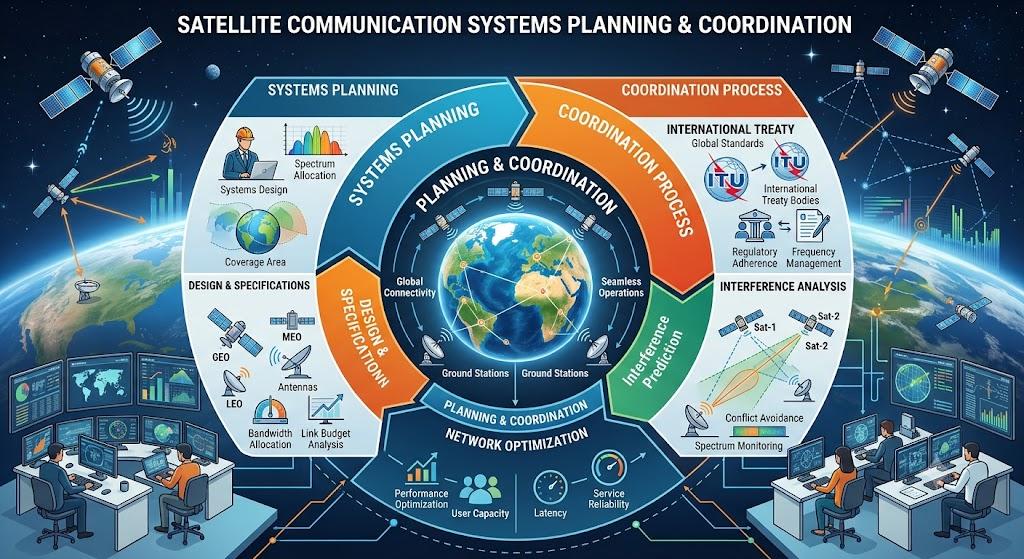
Satellite Communication Systems & IP in Modern Networks
Get all you need to know and more about Satellite Communication Systems & IP in Modern Networks

Course content
Introduction
While legacy satellite systems have achieved remarkable global success, the aerospace and telecommunications sectors are currently on the brink of a revolutionary, software-defined transformation. High-throughput satellites (HTS), Low Earth Orbit (LEO) constellations, and hybrid space-ground architectures are emerging daily, rewriting the rules of global data mobility. To stay competitive, modern network engineers and communications architects must move past legacy configurations and master the seamless integration of satellite transport layers with modern Internet Protocol (IP) infrastructures.
This intensive Advanced Satellite Communication Systems & IP Networking course bridges the gap between traditional aerospace RF engineering and modern enterprise IP networking. Designed as a practical, hands-on masterclass, this course explores the latest advancements in satellite technology with a deep focus on VSAT network design and analysis, IP networking over satellite, and advanced RF mechanics. Participants will gain actionable insights into building resilient satellite communication systems, managing diverse satellite frequency bands, and optimizing satellite communication protocols to ensure high-performance, low-latency data transmission.
Whether you are tasked with managing mission-critical defense links, maritime VSAT infrastructure, or enterprise backhauls, this program equips you with the technical depth and practical workflows required to navigate the complexities of modern satellite-terrestrial integration.
Course Objectives
By the end of this comprehensive training program, participants will be able to:
Master Modern Satellite Communication Systems: Gain a definitive conceptual and practical understanding of satellite communication architectures, ground segment components, and how space assets seamlessly integrate within modern enterprise networks.
Deconstruct How Satellite Communication Works: Analyze the end-to-end physics and engineering of the satellite communication process, tracking data streams from terrestrial uplink centers through orbital transponders down to remote terminal equipment.
Analyze and Deploy Satellite Frequency Bands: Study the distinct operational trade-offs, propagation characteristics, and commercial use cases of various satellite communication bands, including L-band, C-band, X-band, Ku-band, and Ka-band.
Architect Resilient IP Networks over Satellite: Establish rigid engineering requirements for building effective IP-over-satellite links, including strategic IP address allocation, routing optimization, and network configuration tailored for high-delay environments.
Mitigate Security Risks in AAA Frameworks: Identify, audit, and insulate critical vulnerabilities within Authentication, Authorization, and Accounting (AAA) systems deployed across space-ground segments.
Govern Wireless LAN and Edge Access Technologies: Master the role of local wireless loops, Wi-Fi architectures, and specialized terrestrial access technologies in bridging remote satellite terminals with end-user devices.
Audit and Monitor IP Address Usage: Implement precision diagnostics and engineering tools to check, track, and optimize IP address utilization and packet health across multi-node satellite networks.
5-Day Course Roadmap
Day 1: Introduction to Satellite Communication Systems & Multiple Access Techniques
Fundamentals of Global Satellite Systems: Core architecture of modern space-ground systems; understanding the role of space networks in enterprise, maritime, and defense infrastructure.
Next-Generation Orbital Advancements: Exploring High-Throughput Satellites (HTS), software-defined payloads, and the shifting paradigms of modern satellite network management.
Multiple Access Methodologies: Deep-dive analysis of allocation techniques including Frequency Division Multiple Access (FDMA), Time Division Multiple Access (TDMA), Code Division Multiple Access (CDMA), and optimized Random Access models.
Digital Modulation Principles: Mathematical and practical frameworks of Amplitude Shift Keying (ASK), Frequency Shift Keying (FSK), Binary Phase Shift Keying (BPSK), and Quadrature Phase Shift Keying (QPSK).
Spectral Efficiency Mechanics: Deconstructing the relationship between Data Rate and Baud Rate, and calculating how modulation choices directly impact satellite link performance and bandwidth costs.
Day 2: Earth Station Antennas, Pointing, and Tracking
Ground Segment Architecture & Antenna Typologies: Engineering profiles of critical ground infrastructure, including Satellite News Gathering (SNG) antennas, rapid-deploy flyaway systems, and stabilized maritime tracking platforms.
Precision Spatial Alignment: The mechanics of look-angle calculation, polarization alignment, and terminal pointing.
Advanced Tracking Frameworks: Implementing step-track, monopulse, and program-track methodologies to maintain seamless orbital communication paths under volatile environmental conditions.
Day 3: Satellite Frequency Bands & International Regulatory Frameworks
Electromagnetic Spectrum Deep Dive: Comprehensive breakdown of the L-band, C-band, X-band, Ku-band, and Ka-band spectrums; analyzing rain fade, atmospheric attenuation, and optimization strategies for each band.
Global Spectrum Governance: Navigating international and regional regulatory mandates under the International Telecommunication Union (ITU), FCC, and Intelsat.
Compliance and Transmission Constraints: Engineering ground systems within legal limits, focusing on off-axis antenna gain patterns, Equivalent Isotropically Radiated Power (EIRP) density limitations, and cross-pol isolation thresholds.
Day 4: Modern Modulation Techniques & Satellite Communication Protocols
High-Order Modulation and Coding (ModCods): Evaluating advanced Adaptive Coding and Modulation (ACM) systems used in modern DVB-S2X architectures to maintain link stability.
The Satellite Protocol Suite: How the TCP/IP protocol stack behaves over long-delay orbital paths.
IP Over Satellite (IPoS) Optimization: Deploying Performance Enhancing Proxies (PEPs), TCP acceleration techniques, and header compression to maximize data throughput and minimize latency impacts on data networks.
Day 5: Security Risks in AAA, IP Telephony, and Wireless Edge Access
Hardening Space-Ground Security Infrastructure: Auditing and neutralizing critical security risks within AAA (Authentication, Authorization, and Accounting) systems over satellite links.
Voice over IP (VoIP) and IP Telephony Integration: Minimizing jitter, optimizing Quality of Service (QoS), and configuring SIP/RTP profiles for high-performance voice delivery across satellite hops.
Next-Gen Network Architecture: Implementing IPv6 migration strategies, localized DNS caching, and optimized DHCP relay configurations for large-scale satellite deployments.
Edge Wireless & Access Technologies: Integrating Wireless LAN (WLAN) and terrestrial access loops with remote VSAT terminals to ensure seamless end-to-end enterprise connectivity.
Why Attend This Course?
| Strategic Value & Technical Gains (The Wins) | The Risks of Remaining Untrained (The Losses) |
|---|---|
| Flawless IP-over-Satellite Architecture: Gain the exact engineering blueprints required to integrate complex routing protocols, TCP acceleration tools, and bandwidth allocation schemes perfectly with satellite infrastructure. | Bandwidth Inefficiency and Bleeding Budgets: Risk configuring suboptimal links that suffer from massive packet loss, unaccelerated TCP bottlenecks, and soaring transponder lease expenses. |
| Advanced RF & Multi-Band Mastery: Acquire the technical expertise to flawlessly transition between L, C, X, Ku, and Ka-band networks while confidently mitigating rain fade and interference challenges. | Operational Vulnerability to Outages: Leaving your networks exposed to predictable link failures, severe signal degradation, and inaccurate antenna pointing errors that halt corporate operations. |
| Proactive Infrastructure Hardening: Learn to identify and eliminate security vulnerabilities within AAA systems, securing critical control and data planes from modern signal interception. | Severe Cybersecurity Exploitation: Leaving space-ground data pipelines exposed to unauthorized access, malicious data breaches, and heavy regulatory non-compliance fines. |
| Industry-Recognized Technical Credentials: Earn a professional certification from ByB Training Company that formally validates your specialized knowledge to global aerospace, defense, and telecom employers. | Professional and Career Stagnation: Remaining confined to standard, low-margin terrestrial IT routing workflows, locked out of high-stakes aerospace and elite satellite design contracts. |
FAQ
Does this course require prior expertise in orbital physics or aerospace engineering?
No. While a foundational background in basic networking principles (such as an understanding of IP routing and the OSI model) is highly beneficial, this masterclass is systematically structured to build your knowledge from foundational satellite components up to highly complex IP-over-satellite integrations.
Will we learn about modern non-geostationary (NGSO) systems like LEO and MEO constellations?
Yes. Day 1 and Day 4 specifically focus on next-generation software-defined satellite architectures, High-Throughput Satellites (HTS), and the distinct routing, tracking, and handoff challenges associated with Low Earth Orbit (LEO) and Medium Earth Orbit (MEO) networks.
How deeply does this training cover satellite network security?
Security is a core pillar of this curriculum. On Day 5, we dedicate extensive focus to auditing and hardening Authentication, Authorization, and Accounting (AAA) systems, securing terminal management interfaces, and implementing encryption protocols across the space-ground segment.
Conclusion
Mastering modern satellite communication systems, precise network architecture, and advanced IP integration is the ultimate key to unlocking bulletproof operational resilience, global data mobility, and secure cross-border communications. As the global telecommunications infrastructure transitions rapidly toward hyper-dense, software-defined orbital networks, organizations cannot rely on generic, passive IT methodologies.
The Advanced Satellite Communication Systems & IP Networking course moves past surface-level generalities to equip you with rigorous, battle-tested engineering frameworks. Whether your organizational goal is to deploy resilient maritime VSAT nodes, navigate strict ITU international coordination parameters, or secure high-throughput enterprise IP-over-satellite routing networks, this program gives you the exact structural tools required to execute flawlessly.
Secure your registration with ByB Training Company today, safeguard your technical infrastructure, and transform complex orbital telemetry into predictable organizational growth!
Upcoming sessions
| City | Country | Date & time | Price | |
|---|---|---|---|---|
| Istanbul | Turkey | To be announced | £4,900.00 | Register now |
| Amman | Jordan | To be announced | £4,900.00 | Register now |
| Dubai | UAE | To be announced | £4,900.00 | Register now |
| Kuala Lumpur | Malaysia | To be announced | £4,900.00 | Register now |
| Cairo | Egypt | To be announced | £4,900.00 | Register now |
| Casablanca | Morocco | To be announced | £4,900.00 | Register now |
| Cape Town | South Africa | To be announced | £4,900.00 | Register now |
| Amsterdam | Netherlands | To be announced | £5,900.00 | Register now |
| Barcelona | Spain | To be announced | £5,900.00 | Register now |
| Paris | France | To be announced | £5,900.00 | Register now |
| Madrid | Spain | To be announced | £5,900.00 | Register now |
| Rome | Italy | To be announced | £5,900.00 | Register now |
| London | UK | To be announced | £6,100.00 | Register now |