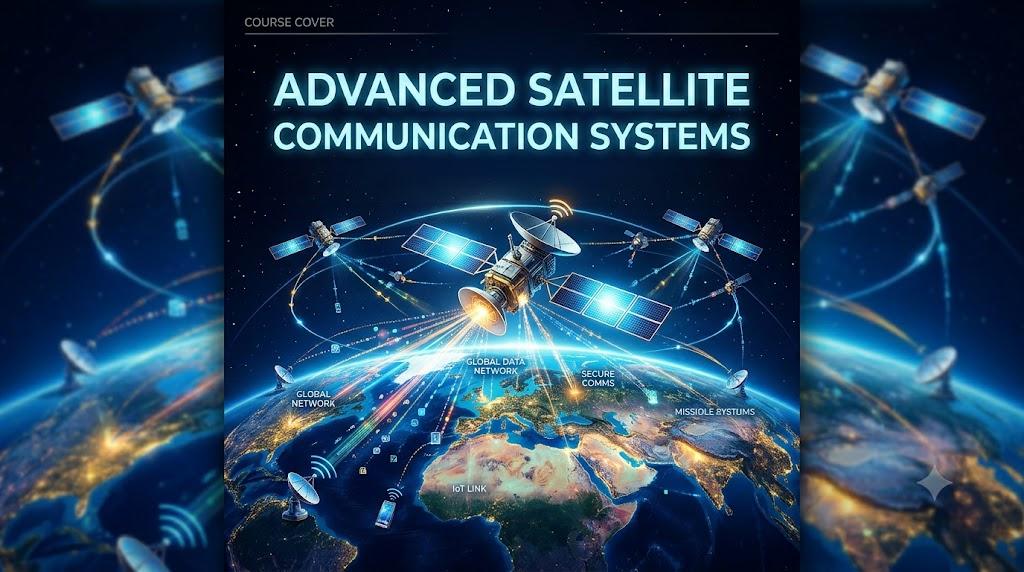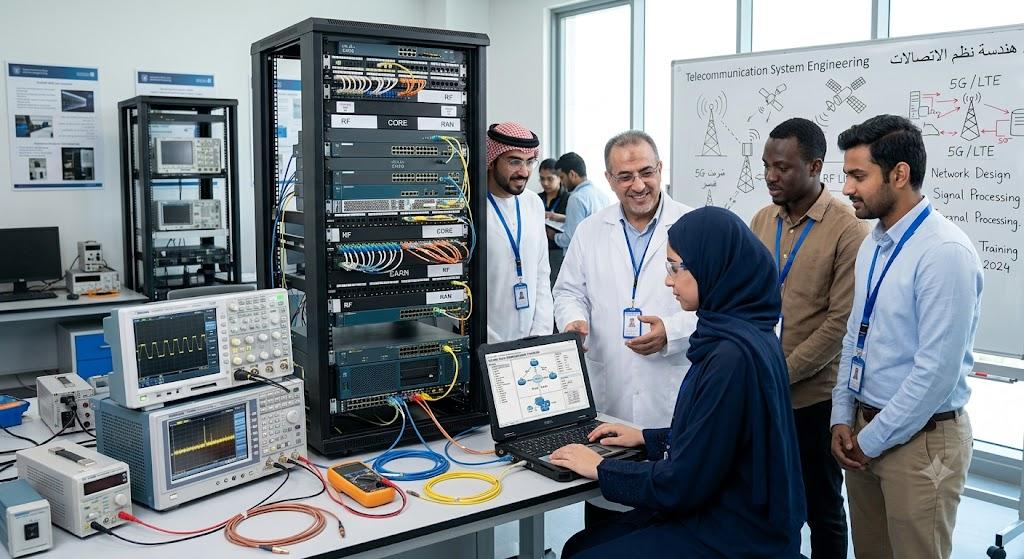
SatMaster Professional-Satellite Link Budget Training
This is a course to explain more about the characteristics of the satellite link as well as software tools like Excel and SatMaster

Course content
- Command Satellite Link Design Principles: Deeply understand the physical and mathematical fundamentals of satellite link budget analysis and apply them to real-world deployment challenges.
- Calculate End-to-End Link Budgets: Perform precise manual and software-driven link budget calculations for sophisticated uplink and downlink configurations, with an emphasis on VSAT networks.
- Master SatMaster Pro Software: Navigate the full interface of SatMaster, building highly accurate predictive models, processing environmental parameters, and troubleshooting signal loss profiles.
- Optimize Spectral and Network Efficiency: Structure and fine-tune satellite networks to handle varying data rates, optimize carrier positioning, and lower lease costs while preserving target quality of service.
- Mitigate Atmospheric and Propagation Loss: Evaluate and design for frequency-specific propagation challenges, choosing the correct band architectures, establishing power control loops, and modeling rain fade profiles.
- Deploy Next-Generation Satellite Features: Implement and evaluate advanced techniques such as Adaptive Coding and Modulation (ACM), carrier-in-carrier bandwidth cancellation, and adaptive power control.
- Comprehensive classification, orbit types (GEO, MEO, LEO), and physical characteristics of modern satellite communication systems.
- Fundamental architectures of VSAT systems: Core engineering mechanics, data pathways, and operational functions.
- Electromagnetic spectrum mapping: Analyzing satellite frequency bands (UHF, L, S, C, X, Ku, Ka) and their specific impacts on signal behavior.
- Comprehensive structural teardown: Detailed engineering block diagrams of VSAT Earth Stations and hardware components.
- Network topologies (Star, Mesh, Hybrid) and advanced multiple access techniques (FDMA, TDMA, SCPC).
- Industry-standard nomenclature, definitions, and technical reference terms used by satellite operators.
- Establishing standard operational assumptions and ground rules for empirical satellite link budget analysis.
- Footprint analysis and parameter interpretation: Extracting and applying EIRP, G/T, PFD, and SFD metrics from satellite contour maps.
- Radio propagation physics: Modeling isotropic sources, line-of-sight geometries, and atmospheric constraints (rain fade, tropospheric scintillation, ionospheric effects).
- Satellite payload antenna characteristics: Analyzing radiation co-polar and cross-polar patterns, beamwidth gain, and front-to-back isolation ratios.
- Ground segment power infrastructure: High Power Amplifier (HPA) operating characteristics, intermodulation distortion, back-off strategies, and uplink power control.
- Digital modulation schemes (QPSK, 8PSK, 16APSK) and advanced Forward Error Correction (FEC) algorithms.
- Bandwidth limitation vs. power limitation: Evaluating symbol rates, channel spacing, and filter roll-off factors.
- Practical derivation and execution of the fundamental space-link transmission equations.
- Advanced, sequential execution of complex link budget formulas for multi-carrier architectures.
- Engineering the Uplink: Calculating Earth station transmission margins, input back-offs, and atmospheric penetration.
- Engineering the Downlink: Calculating satellite transponder output profiles, path loss, and receiver G/T performance.
- Adjacent Satellite Interference (ASI) engineering: Calculating Uplink and Downlink ASI boundaries to comply with strict regulatory spacing coordination.
- Micro-modeling rain attenuation: Applying ITU-R rain models to determine link availability percentages and calculate accurate rain fade margins.
- Transponder configuration matching: Aligning carrier footprints, power densities, and bandwidth requirements with real-world satellite layouts.
- Structural design trade-offs and constraints when engineering specialized corporate or defense communications.
- Fine-tuning link budget calculations and running iterative sensitivity analyses inside the SatMaster Pro engine.
- Mastering the specialized calculation tools within SatMaster:
- Spectral bandwidth and symbol rate sizing.
- Predicting and calculating exact dates and durations of Sun Outages.
- Spatial data manipulation: Converting D:M:S (Degrees, Minutes, Seconds) coordinates to decimal formats.
- Thermal physics calculators: Converting Noise Figure (dB) to equivalent Noise Temperature (Kelvin).
- Antenna beamwidth and target alignment calculators.
- Supervised engineering lab: Executing raw link budget scenarios, modeling complex ASI risks, and cross-verifying software outputs against manual equations for maximum engineering reliability.
- Implementing Adaptive Uplink Power Control (AUPC) loops to dynamically combat severe local weather attenuation.
- Designing and implementing Adaptive Coding and Modulation (ACM) systems to ensure uninterrupted link availability during rain fade events.
- Carrier-in-Carrier (CnC) / Bandwidth Cancellation mechanics: Doubling spectral efficiency and adjusting link budget power limits to accommodate overlapping carriers.
- Ground network convergence: Integrating Layer 2 networking topologies, traffic shaping protocols, and deterministic Quality of Service (QoS) frameworks across satellite backhauls.
- Open panel discussion: Engineering the future of high-throughput multi-beam satellites and non-geostationary network architectures.
Operational Wins (What You Gain) | Competitive Losses (What You Risk by Avoiding This Training) |
|---|---|
Elite Software Fluency: Command SatMaster Pro, the leading standard application used by major global satellite operators, giving you immediate operational autonomy. | Blind Reliance on Presets: Being completely dependent on automated tool outputs without understanding the underlying math or how to fix model errors. |
Precision Optimization: Acquire the skill to design multi-band VSAT systems that extract maximum bandwidth out of minimal satellite power, saving substantial transponder lease costs. | Sub-Optimal Space Segment Utilization: Over-specifying hardware sizes or over-buying transponder power due to inaccurate link budget assumptions. |
Flawless Availability Modeling: Accurately anticipate rain fade, sun outages, and structural signal degradation, building bulletproof reliability into your communication networks. | Catastrophic Outages: Deploying mission-critical infrastructure that experiences unexpected signal failure or drops offline during common weather changes. |
Regulatory & Interference Mastery: Learn how to isolate and calculate ASI margins, allowing you to deploy multi-carrier networks without risking legal or operational cross-talk disputes. | Regulatory Non-Compliance: Unknowingly generating out-of-band interference, leading to costly enforcement actions from regulatory agencies or satellite owners. |
Validated Engineering Credentials: Establish yourself as a highly technical, definitive expert in space-link engineering, making your skill set a critical asset to telecom firms worldwide. | Career Stagnation: Remaining constrained to superficial IT workflows, locked out of high-stakes aerospace and satellite architecture design opportunities. |
Upcoming sessions
| City | Country | Date & time | Price | |
|---|---|---|---|---|
| Istanbul | Turkey | To be announced | £4,900.00 | Register now |
| Amman | Jordan | To be announced | £4,900.00 | Register now |
| Dubai | UAE | To be announced | £4,900.00 | Register now |
| Kuala Lumpur | Malaysia | To be announced | £4,900.00 | Register now |
| Cairo | Egypt | To be announced | £4,900.00 | Register now |
| Casablanca | Morocco | To be announced | £4,900.00 | Register now |
| Cape Town | South Africa | To be announced | £4,900.00 | Register now |
| Amsterdam | Netherlands | To be announced | £5,900.00 | Register now |
| Barcelona | Spain | To be announced | £5,900.00 | Register now |
| Paris | France | To be announced | £5,900.00 | Register now |
| Madrid | Spain | To be announced | £5,900.00 | Register now |
| Rome | Italy | To be announced | £5,900.00 | Register now |
| London | UK | To be announced | £6,100.00 | Register now |