Advance Satellite Communication Systems
Exploring Advanced Satellite Communication Solutions: From Basics to Certification and Mastering Global Connectivity
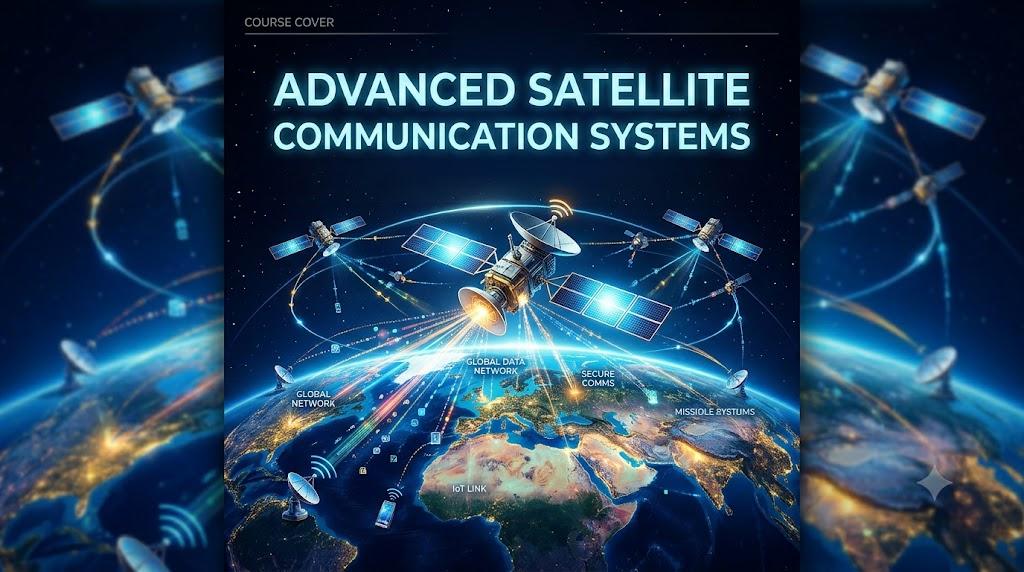
Course content
Introduction
- Master Core Orbital Mechanics: Internalize fundamental principles governing multi-band advanced satellite communications.
- Evaluate Next-Gen Spacecraft Architectures: Analyze breakthroughs in payload engineering, software-defined devices, modular designs, propulsion, and power management.
- Optimize Air Interfaces & Spectral Efficiency: Command advanced communication protocols, forward error correction (FEC), and complex modulation techniques.
- Mitigate Propagation Impairments: Gain engineering insights into signal processing, link degradation, error correction, and robust modulation schemes.
- Design Resilient Space-Ground Architecture: Examine network design and deployment, focusing on inter-satellite links (ISLs) and terrestrial ground stations.
- Troubleshoot Complex Systems: Develop diagnostic skills to model, isolate, and optimize high-stakes end-to-end satellite communication links.
- The Evolution of Space Infrastructure: Architectural history, technological milestones, and socioeconomic impacts of modern networks.
- Orbital Mechanics and System Geometry: LEO, MEO, and GEO constellations, parameters, and coverage footprints.
- Spacecraft Subsystem Integration: Operational components, including communications payloads, transponders, propulsion, power management, and ADCS.
- Demystifying the Space-Ground Interface: Link budget analysis and executing packet-loss-free transmission to terrestrial hubs.
- The Software-Defined Satellite Revolution: CubeSats/SmallSats, modular payloads, and on-orbit reconfigurability.
- Orbital Maneuverability & Station Keeping: Chemical, electrical, and ion propulsion systems for insertion, collision avoidance, and decommissioning.
- Space-Segment Power Management: Long-term power generation, thermal control, and high-efficiency battery storage in harsh environments.
- Advanced Antenna Systems: Phased arrays, multi-beam reflectors, steerable spot beams, and deployment mechanics for spectral reuse.
- Multi-Access Network Topology: Channel allocation protocols comparing TDMA, CDMA, and FDMA.
- Maximizing Throughput via Higher-Order Modulation: QPSK, 8PSK, and high-density Quadrature Amplitude Modulation (QAM).
- Preserving Data Integrity: Forward Error Correction (FEC) structures to repair long-distance signal corruption.
- Dynamic Link Optimization: Adaptive Coding and Modulation (ACM) to maintain link availability during atmospheric attenuation.
- Atmospheric Propagation Mechanics: Path loss, free-space attenuation, rain fade, ionospheric scintillation, and thermal noise across C, Ku, and Ka bands.
- Digital Signal Architectures: Digital modulation, demodulation, and filtering at transponder and ground terminal levels.
- Advanced Error Correction Standards: Convolutional, Reed-Solomon, Turbo, and Low-Density Parity-Check (LDPC) coding.
- Receiver Synchronization Mastery: Carrier recovery, phase-locked loops (PLLs), bit timing synchronization, and clock alignment under low SNR.
- Constellation Network Design: Structural engineering of hybrid, multi-layered space networks across GEO, MEO, and LEO orbits.
- The Space-Based Mesh Network: Designing high-bandwidth Optical Inter-Satellite Links (ISLs) and cross-link data routing.
- Terrestrial Infrastructure Engineering: Ground station subsystems, Earth station antennas, HPAs, LNAs, and baseband routing operations.
- Applied Engineering Practicum: Case studies, modeling exercises, and simulation-driven validation of complex satellite systems.
The Professional Wins (What You Gain) | The Operational Losses (What You Risk Missing) |
|---|---|
Elite Engineering Status: Earn a satellite communication certification validating your technical expertise globally. | Career Stagnation: Risk missing high-level aerospace, defense, or tier-one telecom architecture roles due to lack of verified skills. |
Direct Mentorship: Learn from seasoned RF and aerospace engineering veterans to build core practical skills. | Design and Deployment Failures: Suffer link dropouts, signal attenuation, or unoptimized configurations from relying solely on automated tools. |
Strategic Cross-Industry Vision: Implement high-impact networks across maritime, aviation, energy, and defense sectors. | Technological Obsolescence: Remain restricted to legacy terrestrial IT while software-defined competitors lead orbital rollouts. |
Future-Proof Technical Skillsets: Master LEO mega-constellations, adaptive payload management, and modern satellite solutions. | System Vulnerability & Inefficiency: Expose network infrastructure to miscalculated rain margins, unoptimized link budgets, and costly downtime. |
Upcoming sessions
| City | Country | Date & time | Price | |
|---|---|---|---|---|
| Istanbul | Turkey | To be announced | £4,900.00 | Register now |
| Amman | Jordan | To be announced | £4,900.00 | Register now |
| Dubai | UAE | To be announced | £4,900.00 | Register now |
| Kuala Lumpur | Malaysia | To be announced | £4,900.00 | Register now |
| Cairo | Egypt | To be announced | £4,900.00 | Register now |
| Casablanca | Morocco | To be announced | £4,900.00 | Register now |
| Cape Town | South Africa | To be announced | £4,900.00 | Register now |
| Amsterdam | Netherlands | To be announced | £5,900.00 | Register now |
| Barcelona | Spain | To be announced | £5,900.00 | Register now |
| Paris | France | To be announced | £5,900.00 | Register now |
| Madrid | Spain | To be announced | £5,900.00 | Register now |
| Rome | Italy | To be announced | £5,900.00 | Register now |
| London | UK | To be announced | £6,100.00 | Register now |