Materials Management & inventory Control
A wide understanding of Inventory Management and aims to give all delegates a functional knowledge and understanding of inventory management, control principles, roles, responsibilities, and techniques leading to greater input in the overall Supply Chain strategy of an organisation
Course content
Introduction
Mismanaged inventory is one of the fastest ways to drain an organization's liquid cash. When raw materials arrive late, production lines stall; when excess stock sits idle in a warehouse, it ties up valuable working capital and incurs heavy holding costs. True operational excellence requires moving past basic headcounts and reactive ordering patterns.
This specialized training course bridges the gap between tactical warehouse tracking and high-level supply chain strategy. Engineered for operations supervisors, procurement professionals, and planners, this program breaks down the exact formulas, technical workflows, and data-driven models needed to keep material flows perfectly synchronized with market demand. Participants will master how to optimize stock parameters, eliminate supply chain volatility, leverage modern technical planning tools, and establish rock-solid ledger accuracy that protects organizational profitability.
Course Objectives
By the end of this 5-day professional masterclass, participants will be able to:
Synchronize Operational Material Flows: Align internal replenishment cycles directly with broader corporate supply chain strategies to minimize bottlenecks.
Deploy Advanced Analytical Models: Master quantitative inventory control techniques to determine optimal reorder thresholds and buffer stocks.
Enforce Rigorous Data Integrity: Establish highly reliable auditing processes and stock-checking protocols to eliminate ledger variances.
Implement Predictive Resource Planning: Navigate Material Requirements Planning (MRP) and MRP II frameworks to coordinate raw materials with real-time production schedules.
Eliminate Waste and Overstocking: Apply modern, data-backed stock management tips to safely reduce carrying costs without risking stockouts.
Leverage Integration Technologies: Harness digital communication frameworks to foster collaborative, transparent supplier relationships.
Course Outlines
Day 1: Material Frameworks and Supply Chain Dynamics
Inventory Management Definition: Establishing core principles, terminology, and operational boundaries of modern materials control.
Categorizing Structural Stock: Analyzing different inventory types—raw materials, Work-in-Progress (WIP), and finished goods—and their strategic roles.
The Forrester Effect (Demand Amplification): Deconstructing how forecasting errors compound across the supply chain network.
Physical vs. Information Flows: Mapping the parallel journeys of tangible assets and digital data across business units.
Type I and Type II Supply Chains: Evaluating agile vs. lean distribution models and choosing the right framework for your operational reality.
Statistical Asset Control: Applying standard deviation and probability curves to calculate safe inventory thresholds.
The Service Level Framework: Quantifying the direct financial relationship between buffer stock volumes and customer fulfillment targets.
Day 2: Replenishment Architectures and System Mechanics
Mechanics of Automated Replenishment: Setting up mathematical trigger points within enterprise resource management software.
The Stock-Time Trajectory Curve: Visualizing material consumption rates over time to predict capital depletion phases.
Fixed Order Quantity vs. Periodic Time-Cycle Systems: Balancing the transactional costs of ordering against physical space constraints.
Systematic Auditing and Variances: Structuring cyclical inventory checks to catch tracking discrepancies early.
Managing Dead Assets: Establishing clear governance frameworks to identify, write off, and liquidate surplus or obsolete stock.
Policy Audits: Evaluating current standard operating procedures (SOPs) to remove administrative friction from procurement loops.
Day 3: Quantitative Performance Metrics and Strategic Sourcing
Macroscopic Inventory Assessments: Auditing total warehouse investments against industry benchmarks and asset turnover speeds.
Core Inventory KPIs: Setting up clear dashboards for metrics like Stock Turnover Ratio, Carrying Cost of Inventory (CCI), and Order Fill Rates.
Push vs. Pull Logistics Logic: Shifting from speculative production schedules to demand-driven fulfillment mechanisms.
Agile Market Response Models: Implementing Quick Response (QR) and Efficient Consumer Response (ECR) to match sudden demand shifts.
Collaborative Ecosystems (CPFR): Integrating external supplier schedules with internal forecasts to build a transparent, unified supply network.
Day 4: Tactical Optimization and Stock Reduction Frameworks
Exploiting Supply Chain Leverage Points: Utilizing downstream vendor networks to lower internal handling footprints.
Digital Data Exchange Protocols: Implementing Electronic Data Interchange (EDI) and real-time telemetry to track transit states automatically.
Root-Cause Stock Reduction: Systematically targeting the systemic inefficiencies that force warehouses to hold defensive overstock.
The Seven Operational Rules of Material Planning: Constructing a repeatable, risk-insulated framework for long-term inventory budgeting.
Vendor-Managed Inventory (VMI): Evaluating contractual setups where suppliers take over localized safety-stock management.
Day 5: Industrial Integration and Predictive Planning Architectures
Next-Generation Industrial Tech: Exploring the operational impacts of IoT sensors, automated scanning, and cloud architecture on materials control.
Material Requirements Planning (MRP) Foundations: Breaking down Gross vs. Net MRP inputs to create clean material breakdown structures.
MRP II (Manufacturing Resource Planning): Expanding basic stock planning into a total financial and operational schedule.
Enterprise Integration Hurdles: Resolving software disconnects between production lines, purchasing desks, and financial accounting ledgers.
Developing the 90-Day Execution Plan: Building an actionable, personalized roadmap to implement these optimized frameworks immediately at your workplace.
Why Attend This Course: Wins & Losses!
What You Win (The Strategic Advantages):
Optimized Asset Liquidity: Free up trapped working capital by aligning physical warehouse volumes precisely with realistic market demand.
Flawless Production Continuity: Protect operations from sudden raw-material shortfalls, ensuring assembly lines run smoothly without emergency premium shipping fees.
Audit-Ready Ledger Accuracy: Replace error-prone guess-and-check methodologies with verifiable, automated accounting loops that reflect actual physical counts.
Elite Professional Capabilities: Gain mastery over complex resource planning metrics (MRP/MRP II), making you a highly valuable asset to senior executive supply chain leadership.
What You Lose (The Inefficiencies You Eliminate):
Reactive Firefighting: Say goodbye to chaotic stockouts that trigger rushed purchase orders, sour vendor relations, and alienate key clients.
Invisible Overhead Drains: Eradicate the constant financial leak of holding expired, damaged, or slow-moving stock that wastes expensive warehouse floor space.
Data Blind Spots: Eliminate disconnects between purchasing personnel and warehouse staff, putting an end to mismatched ledgers and unexpected inventory write-offs.
Conclusion
An organization’s financial health is directly tied to the efficiency of its logistics pipeline. The Advanced Materials Management & Inventory Control training course moves beyond basic administrative theory, delivering an execution-focused masterclass explicitly engineered to provide the models, frameworks, and formulas needed to command your physical assets with total confidence.
Secure your seat today to master the digital and quantitative tools necessary to optimize your corporate network, protect organizational profitability, and position your career at the forefront of modern corporate logistics.
FAQ
What is the true materials management meaning in modern logistics?
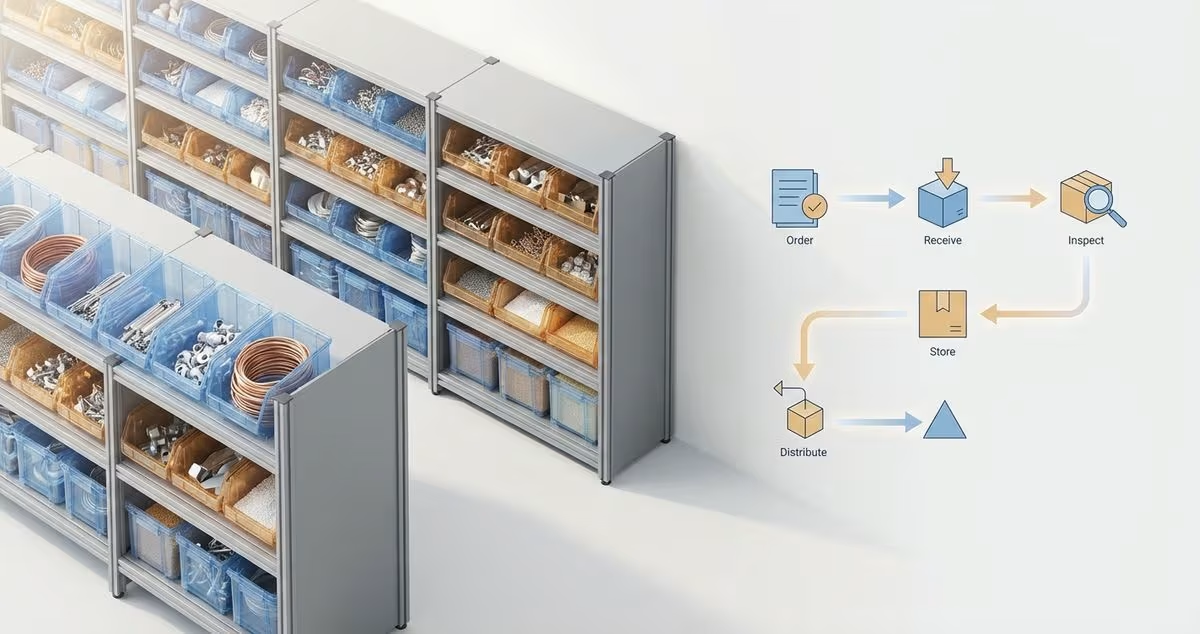
Materials management meaning refers to the strategic planning, procurement, storage, and internal distribution of raw components and physical assets across an enterprise. It focuses on regulating total material flows to ensure that production resources are consistently available while keeping total logistics and handling expenditures at a minimum.
What are the core advantages of material management for an organization?
The primary advantages of material management include significantly lower holding costs, minimized material waste, improved production line efficiency, and enhanced customer satisfaction due to reliable fulfillment. By maintaining optimal stock parameters, businesses protect their cash flow and remain agile when facing global market disruptions.
What is the difference between inventory management and inventory control?
Inventory management is a broad, strategic function focused on long-term demand planning, product lifecycles, and high-level supply chain coordination. Inventory control is a tactical, operational function focused on real-time stock optimization inside the facility; it governs localized asset tracking, safety stock calculations, cycle counting, and the day-to-day replenishment execution.
Upcoming sessions
| City | Country | Date & time | Price | |
|---|---|---|---|---|
| Istanbul | Turkey | To be announced | £4,200.00 | Register now |
| Amman | Jordan | To be announced | £4,200.00 | Register now |
| Dubai | UAE | To be announced | £4,200.00 | Register now |
| Kuala Lumpur | Malaysia | To be announced | £4,200.00 | Register now |
| Cairo | Egypt | To be announced | £4,200.00 | Register now |
| Casablanca | Morocco | To be announced | £4,200.00 | Register now |
| Cape Town | South Africa | To be announced | £4,200.00 | Register now |
| Amsterdam | Netherlands | To be announced | £5,200.00 | Register now |
| Barcelona | Spain | To be announced | £5,200.00 | Register now |
| Paris | France | To be announced | £5,200.00 | Register now |
| Madrid | Spain | To be announced | £5,200.00 | Register now |
| Rome | Italy | To be announced | £5,200.00 | Register now |
| London | UK | To be announced | £5,400.00 | Register now |