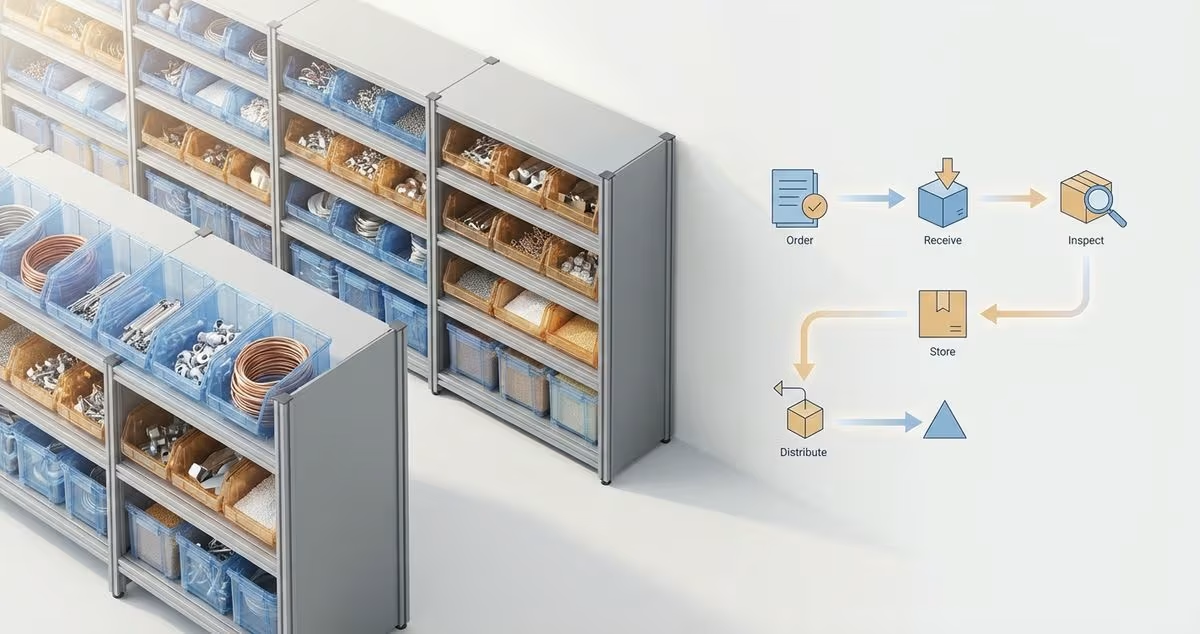
Advanced Warehouse Operations & Management
Learn how to control of the day-to-day operations of a warehouse, such as the shipping, receiving, put-away and picking of goods

Course content
Introduction
In today’s hyper-competitive global marketplace, warehouse and inventory management have evolved from traditional back-office storage functions into critical drivers of corporate profitability and customer satisfaction. A smoothly optimized warehouse acts as the heart of an organization's logistics network, directly impacting fulfillment speed, operational costs, and overall supply chain resilience. Conversely, bottlenecks, layout inefficiencies, and poor stock tracking can quickly result in delayed shipments, bloated overheads, and lost business.
This intensive 5-day professional masterclass is explicitly engineered to upgrade the core competencies of logistics directors, warehouse managers, inventory controllers, and procurement specialists. By moving beyond basic material storage principles, this training dives deep into advanced inventory control techniques, warehouse automation frameworks, data-driven key performance indicators (KPIs), and international import/export compliance frameworks. Participants will gain the practical strategies needed to eliminate operational friction, master vertical and horizontal space utilization, leverage predictive technologies, and transform their fulfillment centers into high-efficiency, cost-saving engines.
Course Objectives
By completing this advanced training program, participants will be able to:
Drive Measurable Performance Gains: Implement modern warehouse management frameworks that systematically reduce cycle times and optimize day-to-day productivity.
Master Strategic Inventory Control: Utilize advanced stock tracking, ABC classification, and demand replenishment formulas to maintain optimal stock levels while slashing carrying costs.
Optimize Workforce and Space Capacity: Develop modern leadership strategies to manage warehouse personnel effectively while maximizing horizontal and vertical square footage footprint layouts.
Resolve Core Operational Bottlenecks: Anticipate, diagnose, and mitigate common warehouse disruptions, layout constraints, and equipment inefficiencies before they impact profitability.
Execute Compliant Import/Export Lifecycles: Design and oversee cross-border logistics strategies, ensuring flawless customs documentation, tariff compliance, and international transport scheduling.
Deploy High-Impact Warehouse Automation: Identify, evaluate, and integrate modern technologies—including Barcoding, RFID, and advanced Warehouse Management Systems (WMS)—to future-proof operations.
Course Outlines
Day 1: The Principles of Modern Warehouse Operation & WMS Integration
Strategic Roles in Global Supply Chains: Analyzing how modern distribution centers act as value-adding fulfillment hubs rather than static storage vaults.
Upstream and Downstream Synchronization: Aligning warehouse receiving capabilities with procurement pipelines and customer delivery networks to eliminate supply chain friction.
Material Flow Optimization: Structural techniques for establishing lean, uninterrupted movement paths from initial receiving to final outbound dispatch.
Leveraging Advanced Warehouse Management Systems (WMS): Evaluating how software platforms automate inventory tracking, improve tracking accuracy, and streamline wave-picking processes.
Data-Driven Performance Metrics: Establishing actionable Key Performance Indicators (KPIs), such as inventory accuracy rates, order picking cycles, and cost per order.
Barcoding and Automated Data Capture (ADC): Deploying RFID, barcoding hardware, and continuous scanning protocols to minimize manual entry errors and achieve real-time visibility.
Day 2: Organizing the Layout for Maximum Flow and Space Efficiency
Strategic Layout Design & Slotting Optimization: Structuring warehouse floor plans to match product velocity, minimize travel distances, and support agile inventory control.
Receiving, Staging, and Dispatching Protocols: Designing standardized operating procedures (SOPs) for rapid cross-docking, error-free receiving verification, and secure outbound loading.
Advanced Space Utilization Frameworks: Strategies for maximizing vertical racking heights, adjusting aisle configurations, and reclaiming underutilized cube space.
Equipment Selection Architecture: Matching operational needs with the correct physical assets, including automated guided vehicles (AGVs), custom racking systems, conveyor setups, and specialized forklifts.
Operational Shift Planning & Capacity Scheduling: Structuring labor forces, shift handovers, and predictive workflows to seamlessly manage seasonal demand spikes and restocking cycles.
Day 3: Managing Spare Parts, Spares, and Just-in-Time (JIT) Frameworks
The Dynamics of MRO (Maintenance, Repair, and Operations) Spares: Tailoring distinct storage and inventory strategies for critical machinery spares vs. standard production materials.
Consignment Inventory & VMI Strategies: Structuring Vendor-Managed Inventory (VMI) frameworks and consignment contracts to shift carrying costs back to suppliers while maintaining stock security.
Implementing Lean & Just-in-Time (JIT) Principles: Applying proven lean practices to sync incoming shipments directly with immediate demand, reducing waste, and freeing up capital.
Mitigating Excess and Obsolete Stock: Constructing systematic audits to identify slow-moving inventory, establish liquidation pipelines, and prevent costly shelf expiration.
Inventory Turnover & Accuracy Auditing: Mastering cycle counting protocols, continuous stock rotation metrics, and wall-to-wall valuation methodologies.
Day 4: Deep-Dive Inventory Analysis, Classification, and Replenishment
High-Velocity Stock Containment Strategies: Advanced quantitative methodologies for accelerating inventory turnover and maintaining perfect transparency across multiple sites.
Discrepancy Remediation: Executing root-cause analysis on inventory variances, shrinkage, and scanning failures to build long-term structural data integrity.
Work-in-Progress (WIP) Management: Managing the storage, tracking, and staging of semi-finished goods moving through complex operational sequences.
Granular ABC Classification & Segmentation: Categorizing inventory by combining financial value with pick frequency to build smart replenishment priorities.
Predictive Replenishment Frameworks: Calculating minimum/maximum limits, safety stock buffers, and economic order quantities (EOQ) to systematically avoid stockouts without over-purchasing.
Day 5: Export and Import Logistics Management & Cross-Border Compliance
End-to-End Cross-Border Logistics Execution: Navigating the end-to-end commercial workflows of moving physical goods across diverse international boundaries.
The Global Trade Documentation Toolkit: Managing bills of lading, commercial invoices, certificates of origin, and electronic shipping declarations.
Customs Clearance, Compliance, and Tariffs: Understanding international trade regulations, harmonized system (HS) codes, and security compliance to prevent costly customs delays.
Fulfilling International Customer Requirements: Aligning packaging, specialized handling, labeling, and delivery timelines with the stringent expectations of global buyers.
Multimodal International Transport Architecture: Critically evaluating air, ocean, rail, and over-the-road freight options to select the most cost-effective and secure transport methods for your cargo.
Why Attend This Course: Wins & Losses!
What You Win:
Drastic Cost Reductions: Eliminate wasted space, minimize obsolete inventory, and slash stock carrying costs through precise quantitative control.
Exceptional Picking Accuracy: Eradicate costly fulfillment errors and order processing delays by deploying modern slotting layouts and automated verification systems.
Optimized Labor and Space Productivity: Reclaim lost horizontal and vertical square footage while designing labor workflows that maximize hourly throughput.
Flawless International Compliance: Protect your business from severe supply chain interruptions, unexpected storage fines, and customs delays through robust trade compliance mastery.
Resilient Global Operations: Turn your storage and fulfillment nodes into high-performing operations capable of adapting to sudden market disruptions.
What You Lose:
Bloated Holding Costs: Say goodbye to capital trapped in unorganized warehouses, redundant safety stock, and unmonitored obsolete parts.
Manual Data Failures: Eliminate reliance on paper checklists, memory-based picking, and messy spreadsheets that introduce operational errors.
Disorganized Layout Constraints: Eradicate chaotic, bottlenecked traffic patterns that slow down forklifts, exhaust picking staff, and compromise workplace safety.
Conclusion
At the end of the day, a company's financial health is directly tied to the efficiency of its fulfillment and storage footprints. The Advanced Warehouse Operations & Management masterclass provides the exact tactical tools, modern frameworks, and technological roadmaps required to transition your warehouse from a cost center into a lean competitive edge.
This isn't a theoretical lecture series where you memorize definitions; it is an intensive, practical toolset designed to permanently upgrade how you track assets, organize space, manage international trade compliance, and lead your logistics workforce. If you are ready to eliminate operational friction, optimize cash flow, future-proof your inventory strategies, and drive sustainable bottom-line growth, this course is your next definitive step.
FAQ
What is the primary difference between warehouse management and inventory control?
Warehouse management focuses entirely on the physical operations, spatial layouts, labor safety, material handling equipment, and execution workflows within the four walls of a facility (such as receiving, slotting, picking, and shipping). Inventory control is a quantitative function focused on stock optimization; it governs total asset values, calculates safety stock, monitors turnover rates, analyzes ABC classifications, and coordinates replenishment strategies across the broader supply chain network to match market demand.
How does warehouse automation technology like RFID and WMS improve operational efficiency?
Integrating modern Warehouse Management Systems (WMS) with automated data tracking like barcoding and RFID removes human error from the tracking pipeline. Instead of manual counts, items are scanned instantly at every transition point. This achieves real-time inventory visibility, slashes pick-and-pack cycle times, optimizes worker travel paths via software algorithms, and completely eliminates manual data entry mistakes, resulting in fulfillment accuracy rates climbing above 99%.
Who will benefit most from enrolling in this advanced warehouse and logistics course?
This professional training program is custom-tailored for mid-to-senior warehouse managers, logistics operations directors, supply chain analysts, inventory control supervisors, procurement managers, and cross-border trade coordinators. It is highly valuable for ambitious professionals holding foundational certifications who want to master advanced automation tech, sophisticated spatial optimization layouts, and complex international import/export regulations to step into senior executive supply chain leadership roles.
Upcoming sessions
| City | Country | Date & time | Price | |
|---|---|---|---|---|
| Istanbul | Turkey | To be announced | £4,200.00 | Register now |
| Amman | Jordan | To be announced | £4,200.00 | Register now |
| Dubai | UAE | To be announced | £4,200.00 | Register now |
| Kuala Lumpur | Malaysia | To be announced | £4,200.00 | Register now |
| Cairo | Egypt | To be announced | £4,200.00 | Register now |
| Casablanca | Morocco | To be announced | £4,200.00 | Register now |
| Cape Town | South Africa | To be announced | £4,200.00 | Register now |
| Amsterdam | Netherlands | To be announced | £5,200.00 | Register now |
| Barcelona | Spain | To be announced | £5,200.00 | Register now |
| Paris | France | To be announced | £5,200.00 | Register now |
| Madrid | Spain | To be announced | £5,200.00 | Register now |
| Rome | Italy | To be announced | £5,200.00 | Register now |
| London | UK | To be announced | £5,400.00 | Register now |