
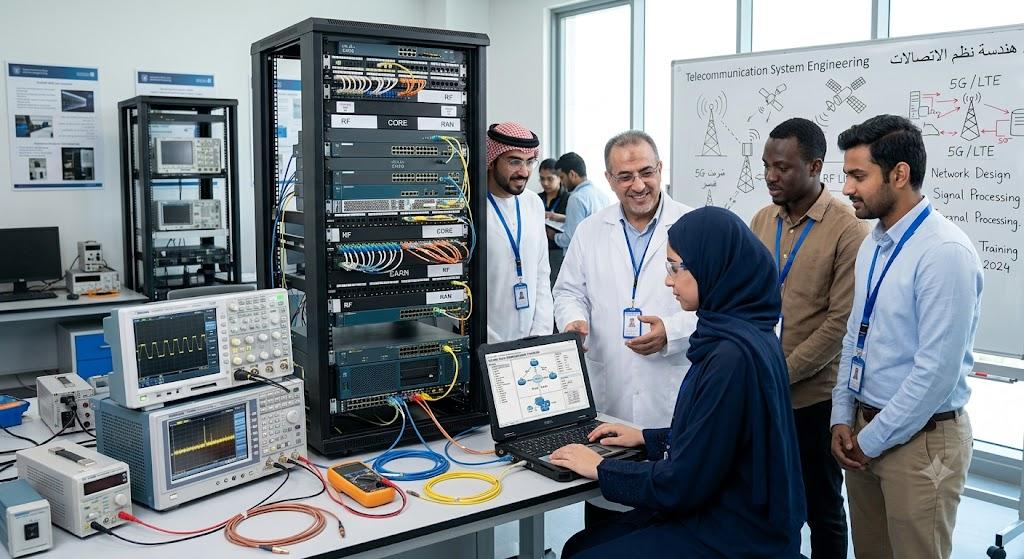
Telecommunication System Engineering Training
Understanding Telecommunication Systems: From Definitions to Advanced Engineering and Integration
Course content
- Deconstruct Telecommunication Frameworks: Define, isolate, and evaluate core telecommunication system functions and their strategic role in supporting high-volume corporate architectures.
- Master High-Speed Digital Architecture: Deeply analyze advanced digital switching mechanisms, high-capacity data communications, and foundational telecommunication system engineering methodologies.
- Execute End-to-End Systems Integration: Implement reliable, battle-tested deployment strategies for complex telecommunications systems integration to maximize multi-vendor network compatibility and throughput.
- Apply Professional Systems Engineering: Master exactly what is systems engineering and directly leverage structured architectural planning to minimize risk and accelerate project timelines.
- Optimize Business Operations: Audit, secure, and fine-tune internal business telecommunication systems to boost day-to-day organizational resilience, reduce downtime, and control costs.
- Anticipate Next-Generation Infrastructure Trends: Evaluate emerging breakthroughs in global telecommunication systems and disruptive network technologies to preserve long-term operational longevity.
- Defining the Telecommunication System: Comprehensive technical breakdown of legacy and modern transmission systems utilized for voice and data transport.
- Anatomy of Signal Degradation: Detailed analysis of the three primary structural impairments—attenuation, distortion, and noise—that threaten voice channel transmission and signal clarity.
- Architectural Topologies: Comparing the operational mechanics, signal flow constraints, and performance use-cases of two-wire versus four-wire transmission links.
- Maximizing Bandwidth Efficiency: The role of frequency-division and time-division multiplexing techniques in increasing throughput and optimizing overall signal delivery.
- Acoustic Engineering Basics: Developing a firm grasp of noise measurement scales, reference units (dBrn, dBm), and physical voice channel shaping criteria.
- The Analog-to-Digital Shift: Quantitative comparison of digital transmission frameworks versus legacy analog methods, focusing on noise immunity and channel capacity.
- Pulse-Code Modulation (PCM) Fundamentals: Technical mechanics of sampling, quantization, and encoding, along with the structural benefits of PCM deployment.
- Line Coding & Signal Recovery: Assessing PCM line coding formats and deploying regenerative repeaters to eliminate cumulative distortion across long-distance lines.
- High-Speed Optical Backbones: Exploring the operational synchronization, frame structures, and scalability of SONET and SDH networks for backbone transport.
- Digital Network Core Functions: Dissecting the vital routing, multiplexing, and signaling functions of telecommunication systems within a pure digital environment.
- Core Switching Paradigms: Evaluating time-division PCM switching versus traditional spatial analog switching, isolating major migration bottlenecks and throughput wins.
- Binary Coding and Data Integrity: Analyzing binary conventions, signaling states, and advanced error detection and correction algorithms (CRC, Parity) in live data streams.
- Physical Layer Management: Master physical interface standards, connector pinouts, and electrical properties governing media connection points in telecommunication systems.
- Modulation over Analog Networks: Examining digital transmission over existing legacy analog local loops using advanced modulation schemes (QAM, PSK).
- Enterprise Technology Convergence: Integrating modern data communication architectures seamlessly into pre-existing, mission-critical business telecommunication systems.
- Topological Design Strategy: Investigating how physical and logical network topologies impact latency, fault tolerance, and implementation overhead in enterprise environments.
- Packet-Switching Mechanics: Analyzing core packet-forwarding paradigms, virtual circuits, and interior gateway routing protocols (OSPF, IS-IS) for efficient traffic management.
- Modern Internet Protocol Frameworks: Navigating the technical architectures of TCP/IP stacks, IPv6 transition strategies, and secure Virtual Private Networks (VPNs).
- Voice and Data Integration: Comprehensive overview of Voice-Over IP (VoIP) deployments, SIP signaling architectures, and Quality of Service (QoS) guarantees.
- Unified Architectural Performance: Understanding exactly how strategic telecommunication systems integration eliminates internal performance friction and unifies disparate data pipelines.
- The FCAPS Operational Framework: Executing systematic fault, configuration, accounting, performance, and security management protocols across complex multi-vendor networks.
- Engineering for High Availability: Designing structural survivability, redundant routing paths, and self-healing mechanisms into internal telecommunication systems.
- Public Network Governance: Analyzing network operations, signaling systems (SS7), and traffic engineering concepts within the Public Switched Telephone Network (PSTN).
- Telecommunication Management Network (TMN): Deploying standardized TMN architectural models to achieve unified system oversight and bulletproof systems engineering planning.
The Professional Win (Choosing to Upgrade) | The Operational Loss (Choosing Inaction) |
|---|---|
Comprehensive Domain Mastery: Develop a definitive grasp of what are telecommunications systems and how to align advanced network layouts with complex corporate performance expectations. | Technological Stagnation: Relying on outdated legacy networking protocols, leaving your company vulnerable to escalating performance bottlenecks and modern security risks. |
Actionable Engineering Capabilities: Gain direct, practical skills in telecommunication system engineering that allow you to troubleshoot multi-layered network issues without reliance on external vendors. | Heavy Vendor Dependency: Spending critical corporate capital on third-party integration consultants because your internal teams lack the expertise to execute complex routing modifications. |
High-Performance Blueprinting: Learn to architect and coordinate seamless multi-platform business telecommunication systems and sweeping global telecommunication systems that easily handle fluctuating traffic loads. | Fragmented Infrastructure: Managing isolated, incompatible data silos that generate unpredictable latency, communication blackouts, and mismatched performance records. |
Immediate Career Acceleration: Gain the specialized expertise needed to lead high-budget network overhaul projects, substantially increasing your market value as an authoritative system designer. | Career Plateaus: Getting trapped in entry-level administrative maintenance workflows due to a lack of verified familiarity with cutting-edge digital backbones (SDH/SONET/VoIP). |
Predictable Problem-Solving: Master the telecommunications systems integration process step-by-step, transforming chaotic network deployments into orderly, highly repeatable structural successes. | Costly Project Delays: Suffering from continuous project scope creep, mismatched vendor software patches, and budget overruns during standard enterprise network updates. |
Future-Proof Infrastructure: Position your organization at the cutting edge of global enterprise growth by tracking and incorporating innovative types of telecommunication systems. | Competitive Obsolescence: Falling behind nimbler, software-defined competitors who leverage next-generation unified communication nodes to accelerate market delivery. |
Upcoming sessions
| City | Country | Date & time | Price | |
|---|---|---|---|---|
| Istanbul | Turkey | To be announced | £4,900.00 | Register now |
| Amman | Jordan | To be announced | £4,900.00 | Register now |
| Dubai | UAE | To be announced | £4,900.00 | Register now |
| Kuala Lumpur | Malaysia | To be announced | £4,900.00 | Register now |
| Cairo | Egypt | To be announced | £4,900.00 | Register now |
| Casablanca | Morocco | To be announced | £4,900.00 | Register now |
| Cape Town | South Africa | To be announced | £4,900.00 | Register now |
| Amsterdam | Netherlands | To be announced | £5,900.00 | Register now |
| Barcelona | Spain | To be announced | £5,900.00 | Register now |
| Paris | France | To be announced | £5,900.00 | Register now |
| Madrid | Spain | To be announced | £5,900.00 | Register now |
| Rome | Italy | To be announced | £5,900.00 | Register now |
| London | UK | To be announced | £6,100.00 | Register now |